


This past summer, I decided to see what this whole “vibe coding” thing was about. I’ve always had a lot of ideas, but actually bringing them to life has historically been a challenge. Suddenly, that barrier seemed a lot lower. I’ve built a few things since then, but one pet project (pun intended) has taken up most of my attention: That Pet Name. More than 70 pets later, I’m starting to wonder whether it’s time to call it quits.
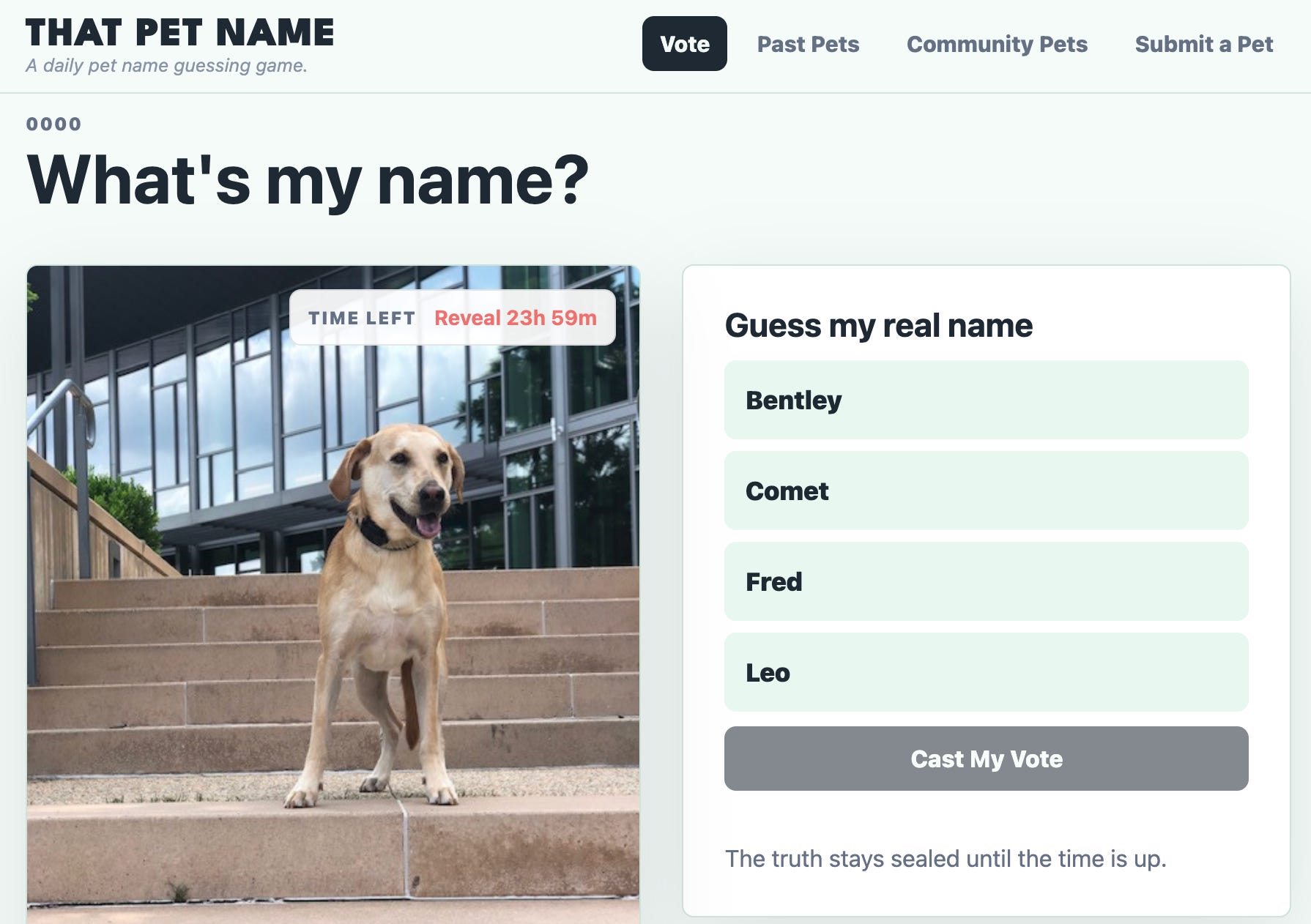
The concept is simple: feature someone’s real pet every day and let people guess its name from four options. I’ve always loved names: children’s names, company names, domain names…you name it. But despite everything AI has made possible, running the thing still requires a surprising amount of work. So I thought I’d share what I’ve learned about what AI does really well, where it still falls short, and why building something is only half the battle.
Building It
I don’t know if this is normal, but I’ve had a lot of fun building ThatPetName.com. It feels like playing with a toy. Every time I think of something to change or add, I just tell Codex. It’s addictive! It has also reminded me how valuable it is to be detail-oriented. Just because AI says it completed something doesn’t mean the work is actually done.
I’ve lost count of how many times I’ve caught something that didn’t turn out quite as I intended. For instance, I asked Codex to add a little snippet about each featured pet, only to discover that it had added the snippet everywhere that pet appeared on the site, including places where it didn’t belong or didn’t look right. These aren’t necessarily big problems, but someone has to notice them. The actual coding is no longer the hard part. Knowing exactly what you want, anticipating how changes might affect other parts of the site, and checking the results over and over still matter enormously.
Marketing It
While building the site has been a blast, marketing it has been considerably less fun. Remember, this is a daily poll. That means I constantly need two things: people submitting their pets and people voting on them. Ideally, I’d also like those voters to subscribe so they come back.
I experimented with paid advertising on Reddit. One of my favorite AI wins was connecting Codex directly to my Reddit Ads account. Since I had separate campaigns for dogs and cats, I had Codex automatically turn the appropriate campaign on or off each day based on which animal was being featured. And it worked! My click-through rate routinely exceeded 5%, which Reddit informed me was phenomenal. (Who doesn’t love a little validation?) I was getting people to the site, and many of them were voting. Some even submitted their own pets, which was a nice bonus. The problem was getting people to subscribe. Plenty of people were happy to spend a few seconds guessing a dog’s name, but far fewer wanted another email in their inbox. Fair enough.
I also experimented with reaching out to pet influencers, asking them to submit their pets and collaborate on Instagram posts. Smaller accounts were often receptive, but while their audiences were happy to comment, that engagement didn’t necessarily translate into new followers.
There’s a lot more I could be doing to grow the audience. I could test different creative, experiment with new channels, refine the conversion funnel, or pursue more partnerships. AI can help with all of these things. I can ask Codex to review my ad performance, research strategies, and suggest improvements. But getting AI to independently manage all of those activities is much harder. There are a lot of judgment calls involved, and I care enough about the brand that I don’t want to hand over the reins and risk a bunch of AI slop appearing under its name.
My biggest takeaway is that AI has made building a product dramatically easier, but getting people to use it is still a whole different skill set. Growth marketers aren’t going anywhere just yet.
Automating It
The website itself is almost entirely automated. People submit their pets, and aside from me managing the queue, everything runs on its own. Every day, the site closes the previous poll, reveals the results, promotes the next pet, emails the owners, and sends updates to subscribers. This is exactly what I wanted.
However, having a website isn’t enough. You also have to be on social media. Every day, I publish posts introducing the featured pet and revealing the previous day’s answer. I’ve especially enjoyed making the reveals. A couple of my favorites are this one and this one. But creating and publishing all this content has been by far the most challenging part of automating That Pet Name.
As I wrote about in my last post, I’ve been trying to learn how to stop doing things myself and instead get AI to do the work. For That Pet Name, that has meant figuring out how to get Codex to create my social content in Canva. I started by writing a detailed playbook explaining exactly how I wanted the posts to look. Every time Codex made a mistake, I’d have it add edit the playbook itself. Eventually, the playbook became a mess of overlapping instructions, repeated rules, and an increasingly long “final” checklist. In trying to make AI more reliable, I had created a document that was becoming increasingly difficult to follow.
Fortunately, a good spring cleaning helped enormously. I consolidated the rules, eliminated duplicates, and established one final quality check that covered the entire playbook instead of letting Codex continually append new things to check. Now, whenever I ask Codex to update the playbook, I explicitly tell it to check whether the instruction already exists before adding anything. Between that cleanup and the work I put into creating templates and branded color palettes, I can finally say that Codex can reliably create my posts and reels. I still occasionally make creative edits myself, but the bulk of the work is done by AI.
I’ve also managed to connect the whole process together. Codex creates the social posts in Canva and writes the captions into a Google Sheet. Make then picks up the media from Canva, matches it with the captions, and sends everything to Buffer, which publishes the posts to Instagram and TikTok. Voilà! In theory, I can sit back and watch the whole operation run itself. (We’ll conveniently ignore the part where I still need a steady stream of pets and voters.)
Except there are a few more problems. First, Canva exports can be buggy. Sometimes, for reasons I have yet to understand, elements simply disappear from the exported video. I’m still mourning the pretzels that never made it into Pretzel’s big reveal post. Second, collaborations aren’t fully automated. Buffer recently introduced the ability to add collaborators to Instagram posts, but that functionality isn’t yet available through the Make integration. So every time I collaborate with a pet owner or influencer, I still have to go in manually and add them.
The last problem is music. Canva has a music library, but the options are more limited than what’s available directly in Instagram or TikTok. Music can make a big difference in a reel, and I haven’t figured out a great way to automate that decision without compromising on the result. None of these problems is insurmountable, but together they mean that my supposedly automated operation still requires a fair amount of human oversight.
I’m sure some of these limitations will disappear in the next few months. The Canva export issues and missing Buffer functionality feel like problems that will eventually get solved. The marketing challenge is different. AI has made it possible for me to build a website, run a daily poll, generate social content, and connect a bunch of tools into a functioning operation, all without hiring anyone. But it hasn’t figured out how to make people care about the thing I built. And despite automating much of the execution, I’m still the one deciding what to test, evaluating what’s working, fixing what breaks, and making sure the output is something I’d actually want people to see.
So I’m at a bit of a crossroads with That Pet Name. I don’t want to walk away from something I’ve had so much fun building, but I also can’t keep pouring time into it indefinitely. I set out to see how much I could build and automate with AI, and 72 pets later, I’ve learned an enormous amount. I guess it’s just not quite as suddenly automated as I’d hoped.